
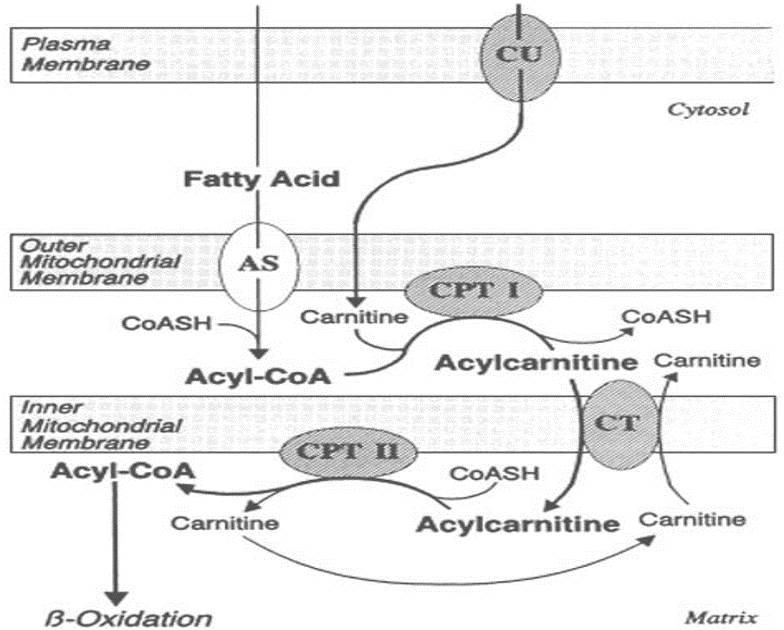
“Differentiating Carnitine Deficiency and Enzyme Deficiencies in the Carnitine Shuttle: Clinical and Laboratory Insights”

Clinical Case: A 6-year-old boy presents to the emergency department with episodes of severe muscle weakness, fatigue, and dark-colored urine after prolonged physical activity. His parents report that he often becomes weak during periods of fasting or intense exercise. Blood tests reveal elevated levels of fatty acylcarnitine and normal levels of free carnitine. Plasma analysis […]
“Differentiating Carnitine Deficiency and Enzyme Deficiencies in the Carnitine Shuttle: Clinical and Laboratory Insights” Read More »

Fatty acid and Triglyceride synthesis- Case-based multiple-choice questions

1. Which of the following TCA cycle intermediates plays a crucial role in de novo fatty acid synthesis by providing substrate and positively regulating the rate-limiting enzyme involved in fatty acid synthesis? A. Citrate B. Isocitrate C. Malate D. Oxaloacetate E. Succinate   Correct Answer: A. Citrate. Citrate plays a crucial role in de novo

Fatty acid and Triglyceride synthesis- Case-based multiple-choice questions Read More »

Glycogen Storage Diseases- Multiple-Choice Questions

1. A 3-month-old male infant presents with poor feeding, hypotonia, and cardiomegaly on physical exam. Blood tests reveal elevated lactate, uric acid, and creatine kinase levels. Echocardiogram demonstrates hypertrophic cardiomyopathy. A muscle biopsy shows excessive glycogen storage in lysosomes. Which enzyme deficiency is most likely responsible for this infant’s condition? A. Glucose-6-phosphatase B. Debranching enzyme

Glycogen Storage Diseases- Multiple-Choice Questions Read More »

Glycogen storage diseases with mnemonics to aid memorization

A table summarizing the main glycogen storage diseases (GSDs) with enzyme defects, key clinical features, and mnemonics to aid memorization: Glycogen Storage Disease Enzyme Defect Key Clinical Features Mnemonic Type I: von Gierke Disease (GSD I) Glucose-6-phosphatase Severe fasting hypoglycemia, hepatomegaly, lactic acidosis, hyperlipidemia, hyperuricemia “von Gierke: ‘G6P’s Gone, Liver Left Low” Type II: Pompe

Glycogen storage diseases with mnemonics to aid memorization Read More »

Glycogen Metabolism- Multiple-Choice Questions with Complete explanations-Part-1

1. Imagine you’re preparing for a long-distance marathon and need sustained energy throughout the race. Which of the following organs stores the maximum amount of glycogen that your body can use during prolonged exercise? A. Adipose tissue B. Cardiac muscle C. Kidney D. Liver E. Skeletal muscle   The correct answer is E. Skeletal muscle:

Glycogen Metabolism- Multiple-Choice Questions with Complete explanations-Part-1 Read More »

HMP Pathway- Multiple-Choice Questions

1. A researcher is investigating the effect of an enzyme whose reaction product is crucial for de novo fatty acid synthesis. Which of the following enzymes is most likely the focus of this study? A. Acyl CoA Dehydrogenase B. Glucose-6-Phosphatase C. Glucose-6-Phosphate Dehydrogenase (G-6PD) D. Lactate Dehydrogenase E. Phosphofructokinase-1 (PFK-1)   Correct Answer – C.

HMP Pathway- Multiple-Choice Questions Read More »

Gluconeogenesis- Case-based multiple-choice questions- Set 2

11. During fasting and feeding states, several enzymes are regulated to maintain glucose and energy homeostasis. Specific biochemical processes occur in an individual at rest who has fasted for 12 hours to adapt to the energy demand. Which of the following occurs in such a state? A. Phosphodiesterase is activated by insulin B. Pyruvate carboxylase

Gluconeogenesis- Case-based multiple-choice questions- Set 2 Read More »

×