Acid-base balance and imbalance

“Master Transcription with Case-Based MCQs: Test Your Understanding!”

1.  A previously healthy 8-year-old develops symptoms of fatigue and anemia. Bone marrow biopsy reveals decreased erythropoiesis, and further molecular analysis shows that the transcription of β-globin mRNA is markedly reduced due to a defect in the assembly of the pre-initiation complex. However, RNA polymerase II is intact and enzymatically functional. Which of the following […]

“Master Transcription with Case-Based MCQs: Test Your Understanding!” Read More »
Acid-Base Disorders- A Quick Revision

Summary Table of Acid-Base Disorders Primary Disorder Defect Causes Effect on pH and Bicarbonate: Carbonic Acid Ratio Compensatory Responses Metabolic Acidosis HCO3⁻ Deficiency High Anion Gap (Acid Gain): – Ketoacidosis (Diabetes, Alcoholism, Malnutrition, Fasting) – Lactic Acidosis (Shock, Hypoxia, Seizures) – Renal Failure – Toxins (Alcohol, Methanol, Salicylates) Normal Anion Gap (HCO3⁻ Loss – Hyperchloremic

Acid-Base Disorders- A Quick Revision Read More »

Acid-base Imbalance- Case Studies With Explanations

Case study1   A 45 year-old-female suffering from bronchial asthma was brought to the emergency in a critical state with extreme difficulty in breathing. The blood gas analysis revealed the following: pH- 7.3 PCO2– 46 mm Hg PO2– 55 mm Hg HCO3– 24meq/L What is your Interpretation? Case details-  Low pH – acidosis Low PO2

Acid-base Imbalance- Case Studies With Explanations Read More »

Acid-base balance-Lecture 3-(Role of lungs and kidney)

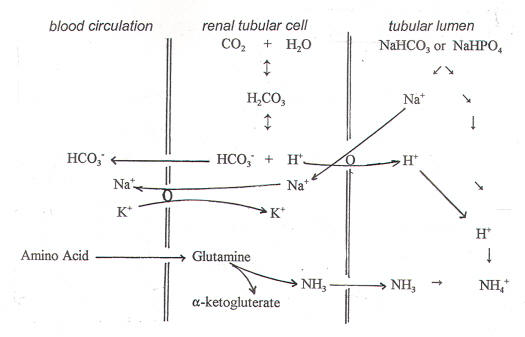
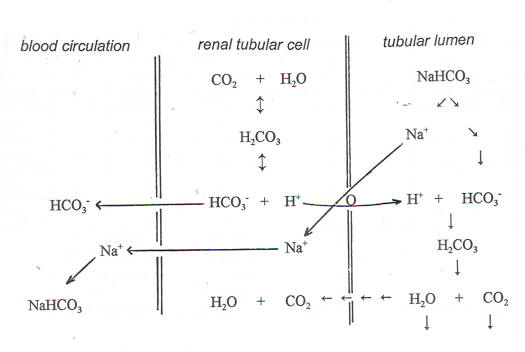
Normal Acid-Base Homeostasis and Role of Lungs Systemic arterial pH is maintained between 7.35 and 7.45 by extracellular and intracellular chemical buffering together with respiratory and renal regulatory mechanisms. The control of arterial CO2 tension (paCO2) by the central nervous system and respiratory systems and the control of the plasma bicarbonate by the kidneys stabilize

Acid-base balance-Lecture 3-(Role of lungs and kidney) Read More »

Acid- base balance- Lecture 2 (Role of blood buffers)

Buffers Buffers are weak acids or bases that are able to minimize changes in pH by taking up or releasing H+. Phosphate is an example of an effective buffer, as in the following reaction: HPO4 2- + (H+)  «H2 PO4 – Upon addition of an H+ to extracellular fluids, the monohydrogen phosphate binds H+ to

Acid- base balance- Lecture 2 (Role of blood buffers) Read More »

Acid-Base Balance-Lecture-1- Significance of pH

Acid-base balance An acid is a substance that can donate hydrogen ions (H+), and a base is a substance that can accept H+ ions, regardless of the substance’s charge. H2 CO3 (acid) «H+ + HCO3 – (base) Strong acids are those that are completely ionized in body fluids, and weak acids are those that are

Acid-Base Balance-Lecture-1- Significance of pH Read More »

Acid-base and electrolyte balance (Multiple-choice questions)

Q.1- A 64-year-old man who develops acute renal failure while recovering from a severe acute myocardial infarction (Acute MI), Blood chemistry reveals: Na+ 140 mEq/L, K+ 4 mEq/L, Cl– 115 mEq/L, CO2 5 mEq/L, pH = 7.12, PaCO2 13 mmHg, and HCO3– 4 mEq/L. Calculate the anion gap and then choose the best answer for acid-base status. A) His anion gap

Acid-base and electrolyte balance (Multiple-choice questions) Read More »

“Comprehensive Guide: Acid-Base Imbalance, Anion Gap, and Clinical Cases”

“Understand acid-base imbalances and their clinical significance. This guide includes cases on metabolic acidosis, respiratory alkalosis, and normal anion gap metabolic acidosis, along with ABG interpretation and renal handling of acids.”

“Comprehensive Guide: Acid-Base Imbalance, Anion Gap, and Clinical Cases” Read More »

Acid-base balance and imbalance, water and electrolyte balance and detoxification-Multiple choice questions

“Challenge yourself with 20 detailed multiple-choice questions on acid-base balance, electrolyte regulation, and detoxification. Learn about ABG interpretation, causes of metabolic acidosis, and key physiological mechanisms.”

Acid-base balance and imbalance, water and electrolyte balance and detoxification-Multiple choice questions Read More »

Multiple-Choice Questions- Acid-Base Balance-Test Your Knowledge!

Q.1- A person was admitted in a coma. Analysis of the arterial blood gave the following values: PCO2 16 mm Hg, HCO3– 5 mmol/l and pH 7.1. What is the underlying acid-base disorder? a) Metabolic Acidosis b) Metabolic Alkalosis c) Respiratory Acidosis d) Respiratory Alkalosis Q.2- In a man undergoing surgery, it was necessary to aspirate the contents of

Multiple-Choice Questions- Acid-Base Balance-Test Your Knowledge! Read More »

×