Theory notes

Electron Transport Chain -strictly aerobic (a brief review)

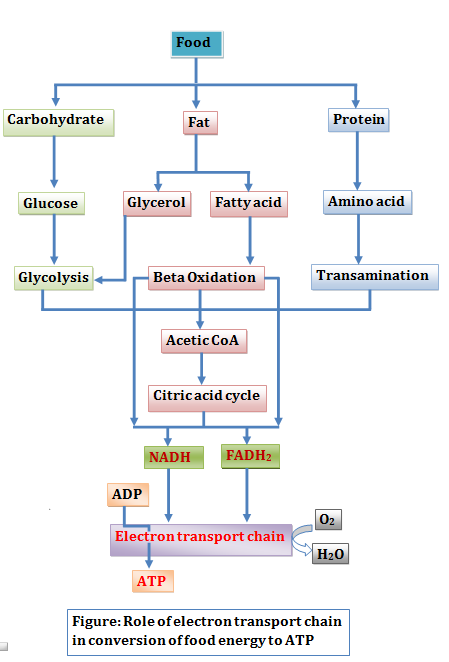
Introduction Most of the energy liberated during the oxidation of carbohydrates, fatty acids, and amino acids are made available within mitochondria as reducing equivalents (—H or electrons). The NADH and FADH2 formed in glycolysis, fatty acid oxidation, and the citric acid cycle are energy-rich molecules because each contains a pair of electrons having a high […]

Electron Transport Chain -strictly aerobic (a brief review) Read More »
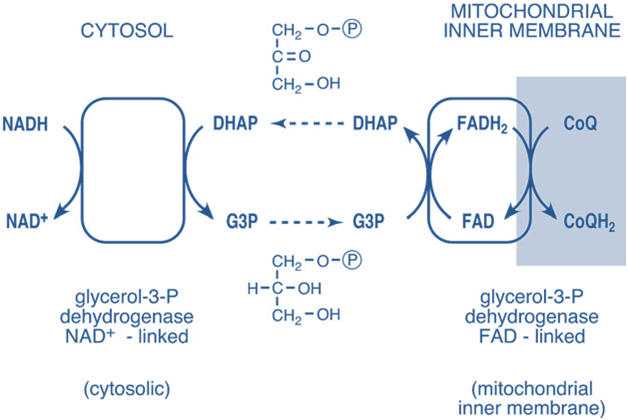
Complete oxidation of glucose in skeletal muscle yields 36 ATPs while in other tissues the yield is 38 – what might be the reason?

Under aerobic conditions regeneration of cytosolic NAD+ from cytosolic NADH is accomplished by transferring electrons across the mitochondrial membrane barrier to the electron transport chain where the electrons are transferred to oxygen. There are two different shuttle mechanisms whereby this transfer of electrons across the membrane to regenerate cytosolic NAD+ can be accomplished, the glycerol 3-phosphate shuttle and the malate-aspartate

Complete oxidation of glucose in skeletal muscle yields 36 ATPs while in other tissues the yield is 38 – what might be the reason? Read More »

Non-shivering thermogenesis : uncoupling of oxidative phosphorylation

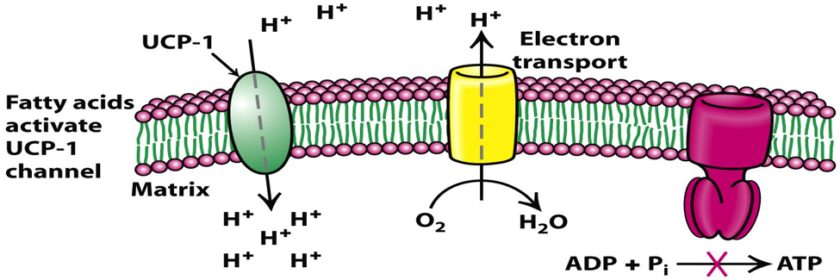
Which of the following occurs in non-shivering thermogenesis? A) Glucose is oxidized to lactate B) Fatty acids uncouple oxidative phosphorylation C) ATP is spent on heat production D) Glycogen is excessively degraded E) Fatty acids are excessively oxidized The correct answer is C- Fatty acids uncouple oxidative phosphorylation Basic Concept The reduction of molecular oxygen

Non-shivering thermogenesis : uncoupling of oxidative phosphorylation Read More »

Electron Transport Chain – An Overview

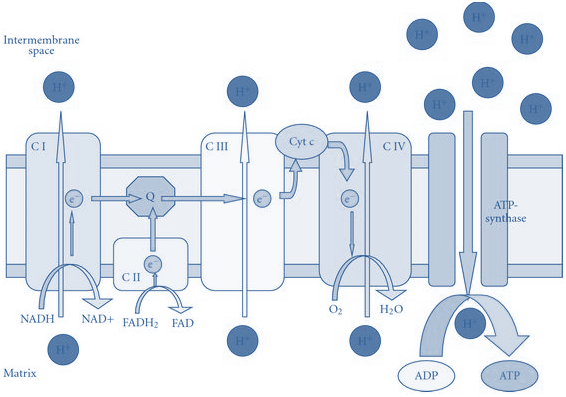
An 18-year-old college student is brought to the emergency room unconscious, with a very high serum alcohol level. Alcohol metabolism can result in high NADH levels. When NADH enters the electron transport chain, which of the following is the correct order in which electron transfer occurs? a) NADH, coenzyme Q, cytochrome c, FMN, O2 b)

Electron Transport Chain – An Overview Read More »

Impaired electron flow through complex II

A -8-year-old boy is seen by an ophthalmologist for difficulties in seeing in all visual fields as well as slow eye movements. The ophthalmologist finds pigmentary retinopathy and ophthalmoplegia. The child is suspected to have Kearns- Sayre syndrome, a disorder due to a mutation in complex II of ETC. The electron transport from which substance

Impaired electron flow through complex II Read More »

Electron transport chain inhibition by Rotenone

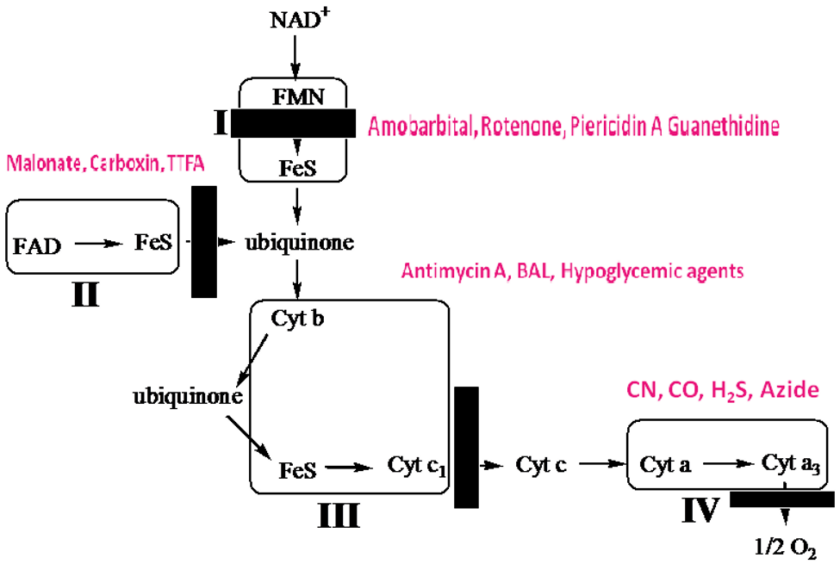
An unskilled worker in a water garden was sent to sweep up a spill of white powder in the storage shed. Later, he was found with labored breathing and convulsions. On further examination, the white powder was identified as rotenone. Respiratory distress is induced by rotenone exposure because it inhibits the complex that catalyzes which

Electron transport chain inhibition by Rotenone Read More »

Reduced state of the respiratory chain carriers (Inhibition of electron transport chain)

As electrons are received and passed down the transport chain, the electron carriers are first reduced with the acceptance of the electron and then oxidized with loss of the electron. A patient poisoned by which of the following compounds has the most highly reduced state of most of the respiratory chain carriers? A. Antimycin A

Reduced state of the respiratory chain carriers (Inhibition of electron transport chain) Read More »

×