Quick Revision Series

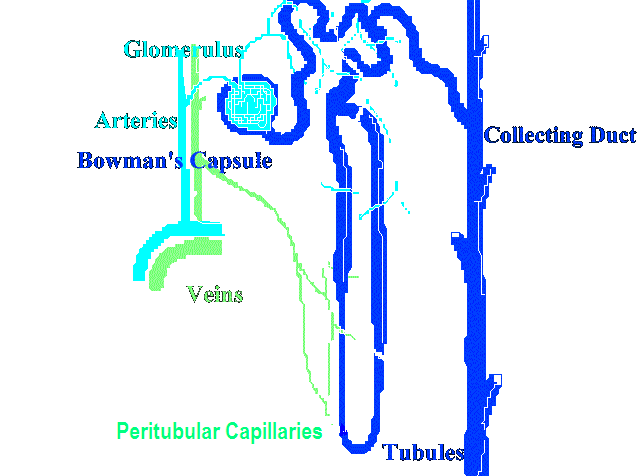
Renal clearance- a quick revision

Introduction Renal clearance is a measurement to analyze the functions of the kidney. By definition, clearance is the volume of plasma from which the excretion completely removes a substance through the kidney in a given amount of time (usually a minute). For example, the clearance for urea is 75 ml/min. This means that the kidney […]

Renal clearance- a quick revision Read More »
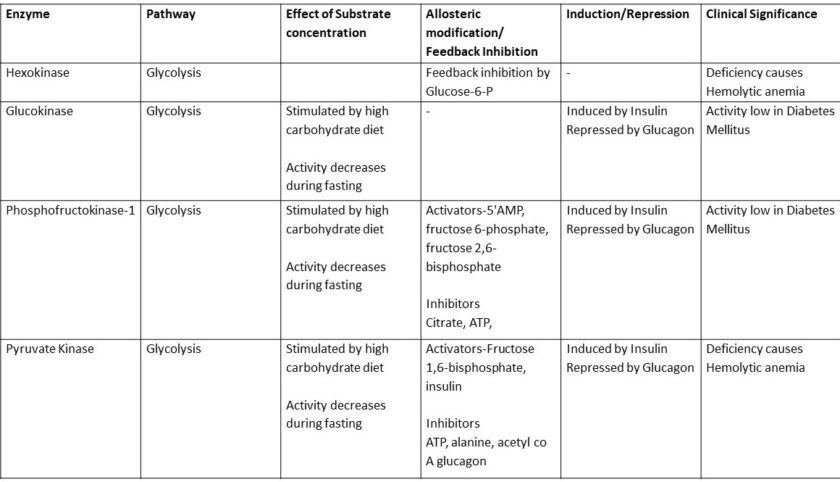
Summary- Regulation of Major Pathways Of Carbohydrate metabolism

Enzyme Pathway Effect of Substrate Concentration Allosteric Modification/ Feedback Inhibition Induction/Repression Clinical Significance Hexokinase Glycolysis Feedback inhibition by Glucose-6-P – Deficiency causes Hemolytic anemia. Glucokinase Glycolysis Stimulated by a high carbohydrate diet   Activity decreases during fasting – Induced by Insulin Repressed by Glucagon Activity low in Diabetes Mellitus Phosphofructokinase-1 Glycolysis Stimulated by a high

Summary- Regulation of Major Pathways Of Carbohydrate metabolism Read More »

Regulatory Mechanisms- Lipid Metabolism (Summary Chart)

Enzyme Pathway Effect of substrate concentration Allosteric Modification/Feedback Inhibition Induction/ Repression Clinical Significance Acetyl CoA  Carboxylase Fatty acid synthesis Activity increases during well-fed state Activity decreases during fasting Activator- Citrate, ATP Acetyl CoA Insulin-by causing de-phosphorylation by stimulating protein phosphatase Inhibitors- Long-chain fatty acids, Epinephrine, Glucagon- via changes in phosphorylation state through c AMP mediated phosphorylation cascade Induced

Regulatory Mechanisms- Lipid Metabolism (Summary Chart) Read More »

Metabolic disorders- Carbohydrate metabolism

S.N. Process/Pathway affected Disease Major Manifestation 1) Digestion Lactose intolerance Sucrase/Isomaltase deficiency Inability to digest dairy products, bloating, pain- abdomen, diarrhea or constipation, etc. 2) Absorption (SGLT-1or SGLT-2 deficiency) Glucose/Galactose malabsorption   Impaired dietary glucose/galactose absorption (SGLT-1), or Renal glycosuria (SGLT-2) 3) Glycolysis Hexokinase or Pyruvate kinase deficiency (   Hemolytic anemia 4) PDH Complex

Metabolic disorders- Carbohydrate metabolism Read More »

Biologically important peptides

A 56-year-old man with long-standing poorly controlled diabetes mellitus visits his primary care physician for a follow up after recent hospitalization. The patient experienced an episode of acute renal failure while in the hospital and his creatinine level rose to 4 mg/dl. Creatinine, a marker of renal function is produced from which of the following

Biologically important peptides Read More »

×