Chemistry of Carbohydrates

Multiple-choice questions- Chemistry of carbohydrates- Revision- Set-2

Q.1- Which of the following is not a disaccharide? a) Hyaluronic acid                                             b) Maltose c) Lactose                                            d) Sucrose                                                           Q.2- What is the molecular formula of Glucose? a) CH3OH                                             b) C12H22O11 c) C6H1206                                                             d)  C6H12O5                                            Q.3-Sucrose is composed of which two sugars? a) Glucose and Glucose                                 b) Glucose […]

Multiple-choice questions- Chemistry of carbohydrates- Revision- Set-2 Read More »
Chemistry of Carbohydrates- Multiple-choice questions- Revision- Set-1

Q.1- Which of the following is a non- reducing disaccharide? a) Galactose                                                                       b) Maltose c) Trehalose                                                                       d) Sucrose                                              Q.2- Which of the following is a true statement about glucose? a) It cannot be utilized by red blood cells b) It has 4 asymmetric carbon atoms c) It is stored as starch in

Chemistry of Carbohydrates- Multiple-choice questions- Revision- Set-1 Read More »

Multiple-Choice Questions- Chemistry of Carbohydrates-set-3

Q.1-Which of the following is a simple sugar or monosaccharide? a) Galactose b) Lactose c) Maltose d) Sucrose Q.2- What is the molecular formula of Glucose? a) CH3OH b) C6H1206 c) C12H22O11 d) C6H12O5 Q.3- Maltose is composed of which two sugars? a) Glucose and Glucose b) Glucose and Galactose c) Glucose and Fructose d)

Multiple-Choice Questions- Chemistry of Carbohydrates-set-3 Read More »

Heparin- Mechanism of action-a case study

Case Details A 54 –year- old woman who was bed-bound in a nursing home began to develop swelling of her left leg. She was evaluated with venous Doppler ultrasound and was found to have a deep vein thrombosis. She was immediately started on heparin to prevent the clot from further enlarging. What is the chemical

Heparin- Mechanism of action-a case study Read More »

Storage Polysaccharides

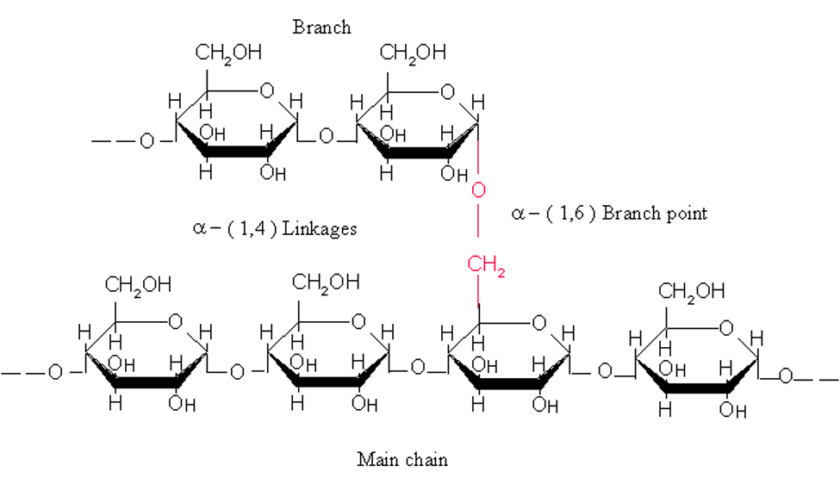
Glycogen, Starch and Inulin are storage polysaccharides. 1) Glycogen  Glycogen is a readily mobilized storage form of glucose. It is a very large, branched polymer of glucose residues (Figure-1) that can be broken down to yield glucose molecules when energy is needed. Most of the glucose residues in glycogen are linked by α-1,4-glycosidic bonds. Branches at

Storage Polysaccharides Read More »

Monosaccharides- Ring structures and Mutarotation

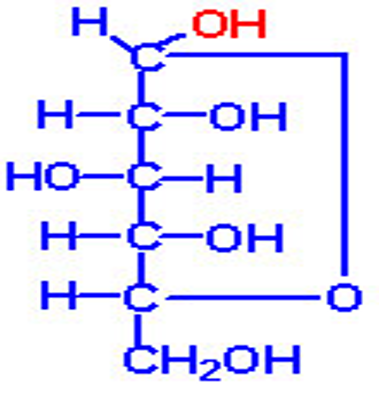
Representation of the ring structure of monosaccharides The ring structures of monosaccharides can be represented as follows : 1) Fischer projection The acyclic structure of a sugar is commonly shown by using a Fischer projection. A Fischer projection is sometimes used to illustrate the cyclic hemiacetal form of sugar. The presence of an aldehyde group and

Monosaccharides- Ring structures and Mutarotation Read More »

Isomerism in Monosaccharides

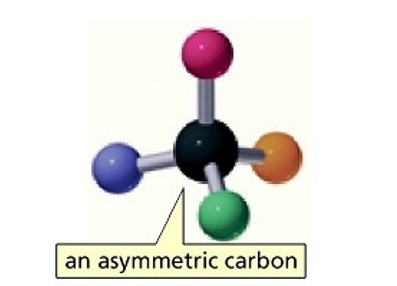
Isomerism in monosaccharides The monosaccharides having asymmetric carbon atoms exhibit isomerism. Asymmetric carbon atom- It is the carbon atom that is attached to four different groups (Figure-1) Figure-1- An asymmetric carbon atom with 4 different attachments All monosaccharides except- Dihydroxyacetone, have asymmetric carbon atoms (Figure-2) Figure-2- Glyceraldehyde has an asymmetric carbon atom whereas dihydroxyacetone lacks, thus

Isomerism in Monosaccharides Read More »

Chemistry of Carbohydrates- classification and significance

 General Introduction Carbohydrates are the most abundant compounds found in nature (cellulose: 100 billion tons annually) They make up most of the organic matter on earth because of their extensive roles in all forms of life. One of the four major classes of biomolecules along with proteins, nucleic acids, and lipids. The term carbohydrate is derived

Chemistry of Carbohydrates- classification and significance Read More »

Sanfilippo syndrome

Case details A 6-year-old boy is seen by a pediatrician because his parents are concerned about his aggressive behavior, hyperactivity, and a loss of language skills. He also has recently become increasingly unsteady on his feet and has experienced a recent seizure. Slight facial feature coarsening is noted. In which of the following processes is this child

Sanfilippo syndrome Read More »

×